Week 10: Steaming & Seafood II
Updated: Nov 2, 2023
Research
Introductions
List the method of cookery and dishes to be covered in class
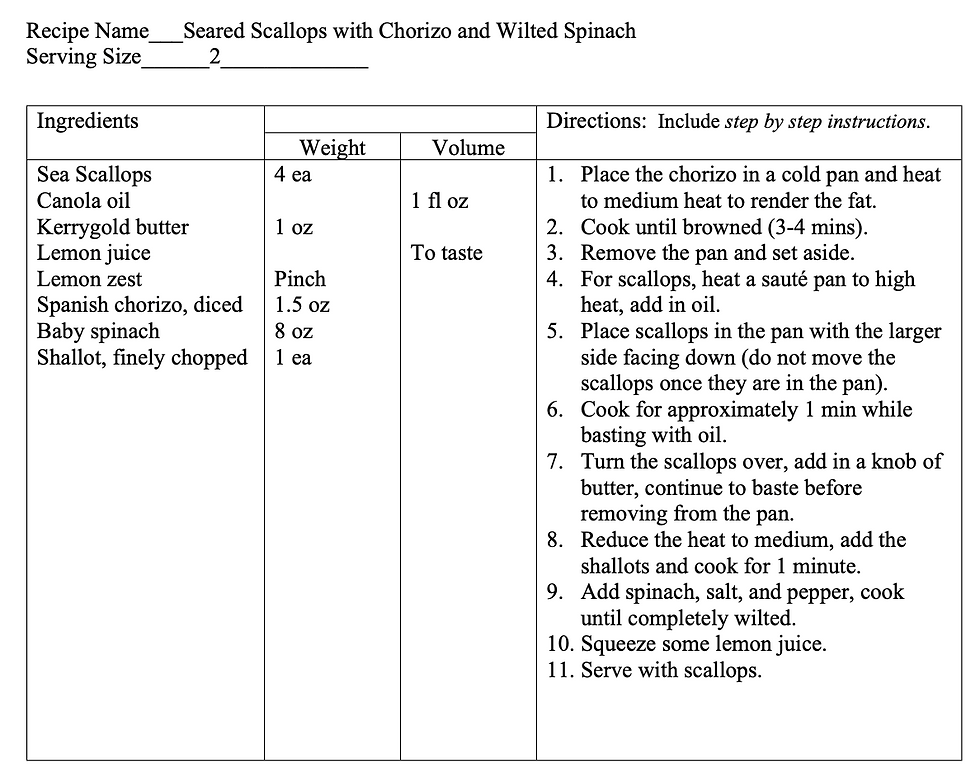
This week we will be utilizing the last moist-heat method of cooking by steaming red snapper. More specifically, we will be cooking en Papillote by steaming the fish along with leek, fennel, carrot, celery and red bell pepper inside sealed parchment paper. On a heart-shaped piece of parchment paper, the snapper will be placed on top of the vegetables, skins side up, topped with basil butter, then sealed to be baked at 450 degrees for 8-10 minutes. In accompaniment, we will be cooking risotto through a long simmering process. After bringing chicken stock to a simmer, we use a separate large, heavy saucepan to saute onions in butter, to which we will add arborio rice then wine until absorbed. Slowly we will add the stock with saffron threads to the pan in 2 ounce portions, stirring frequently, until all stock is used which will take 18-20 minutes. We will remove the tender rice from heat and add butter and grated parmesan cheese. We will be working with shellfish for the first time, specifically sea scallops. We will begin by heating chorizo until melted and browned. Separately, we will use a saute pan on high heat with oil. We will place the scallops larger side down, unmoved, while basting with oil for approximately one minute. After turning them over, we will add butter and baste before removing the pan. The heat will be reduced to medium and we will add finely chopped shallots for one minute before adding baby spinach, salt and pepper, cooking until completely wilted, and topped with a squeeze of lemon juice. This will be served with the sea scallops.
List your learning objectives for the class
I have steamed a few types of food before, such as broccoli, using a basket over boiling water, but I have never used the en Papillote method. My goal is to successfully demonstrate this new cooking method, assuring that the parchment paper is correctly folded and the red snapper gets cooked all the way through. Searing the scallops until they are completely cooked will be tricky, but I aim to sear delicious scallops that are throughly cooked (so that I don't get sick a third time from eating scallops). Nonetheless, I am excited to try red snapper for the first time!
Discuss your prior knowledge of the content
Prior to my research, I was familiar with the color change of cooked scallops, but not the cooking time. One sign that scallops are done cooking is the center turns opaque and the edges are a golden brown color. Shellfish is one of the most common causes of food poisoning because they may contain toxins from contaminated water or algae. I have gotten food poisoning twice throughout my life after eating scallops, which was most likely caused by the shellfish being slightly undercooked and contaminated with marine toxins.
Background Information
Research and discussion of method of cooking/ techniques
Steaming is another moist-heat method of cooking that uses the process of convection to transfer heat from the steam to the food, in this case, red snapper fish. One common steaming method is performed on the stove top with a basket above boiling liquid and covered to retain steam. Another option is the use of a pressure cooker. But this week we will employ a specific steaming method called en Papillote, which means cooking food in paper or foil to retain moisture. Steamed food should be served immediately. Risotto is a more complicated technique of cooking rice as it requires a slow addition of stock and frequent stirring, rather than dumping rice into water and covering to simmer to finish or cooking in a pressure cooker, as is common with long-grain rice. Pan-searing sea scallops is a very common method for this shellfish. It is a fast method of cooking, as scallops are cooked for just a few minutes on each side with oil and butter. The availability of fresh sea scallops in our location is limited. An article published by Eating Well says, “It's better to choose frozen scallops, which are immediately frozen after harvesting when scallops are at their best. If you're looking for a more affordable option, bay scallops are generally less expensive than their larger sea scallop counterparts” (Loh, 2023).
Research and discussion of primary ingredient
Red snapper is the prime ingredient in our fish recipe, which is caught in the Gulf of Mexico. When buying snapper, one should look for clear, red eyes and bright red skin. An article by The Spruce Eats asserts that “Red snapper has a firm texture and a sweet, nutty flavor that lends itself well to everything from hot chilies to subtle herbs. Whole red snapper can be broiled, grilled, pan-fried, steamed, baked, or deep-fried. Fillets are good pan-fried or steamed. Red snapper is also a nice ingredient in fish stew, such as cioppino” (Riches 2022.) A benefit of red snapper is its nutritional value; it has high levels of omega-3 fatty acids, selenium, magnesium, and vitamins D and E (Zellman, 2022). The main ingredient in risotto is arborio rice. Common grains in the American diet are rice, corn, and wheat. A competitor to pasta in many dishes, rice allows the flavor to be absorbed and is a nice accompaniment to meat dishes but is also often used in stews and casseroles. We will be using arborio rice, a short-grain, which has more starch and is sticky rather than fluffy, compared to long-grain rice, with a white color and mild flavor. Rice is incorporated into many recipes and may include wild rice, black rice, basmati rice, long-grain brown, red converted, and the popular long-grain white rice. If the chosen rice doesn't have enough starch, then the desired creamy texture of a good risotto cannot be achieved (Gallary, 2023). The main ingredient in seared scallops is scallops. We will be searing sea scallops, which are the largest variety compared to bay scallops and calico scallops, and the most expensive. It is important to choose scallops of similar thickness to promote even cooking. Scallops are known for their tender consistency and delicate flavor, but bay scallops will be more tender. When discussing cooking times, a 2019 article notes, “While sea scallops are larger, they’re still delicate and benefit from short cook times, whether they’re sautéed, grilled, or poached” (Foster, 2019).
Dish/method variations - discuss the variations of the dish or the methods of cooking
In past weeks, we broiled sea bass with a dry-heat method, and poached flounder with a moist-heat method. Red snapper could certainly be broiled or poached, but also grilled or baked. Broiling uses heat from above, with the food placed on a rack under the broiler element in an oven. The intense heat quickly sears the top surface of the food, giving it a crispy and caramelized texture. Poaching may use a submersion method where liquid completely covers the food, or shallow poaching, where the liquid comes halfway up the sides of the dish. Steaming is considered the most healthful of the methods as no fats or oils come in contact with the food. Scallops are available in varieties. Sea and bay scallops are both cold-water varieties, but sea scallops are much larger. Calico scallops are a warm-water variety and are the smallest of the three types. We will be pan searing sea scallops, but they are also commonly poached or simmered. Risotto requires a rice with high starch content that holds up well to constant stirring. Other rice sometimes used for risotto are carnaroli and vialone nano because of their high starch content, yet they have different grain size and starch content. Tasting Table warns, “when it comes to risotto, never — we repeat, never! — rinse rice. Since starch is such a fundamental component of the dish that washing will simply rid the plump grains of their vital starches. After all, only rice with the highest level of starch can produce the most luscious risotto” (Tomczak, 2023).
Recipes


Plan of Work

Report & Reflect

Results
Describe the outcomes of the lab class:
Class this week went very well. We successfully steamed red snapper and served the dish on a bed of celery, carrots, fennel, and red bell pepper slices. The red snapper tasted delicious, with warm aromas of melted. butter. The process of making the risotto started out a little rough, but the end result had the perfect texture and cheesy taste that we desired. The pan-seared scallops were a bit too seared on the edges but exhibited a delicious crab-like flavor and paired well with the cooked spinach. The cooking process was stressful all around; still, each part of the dish turned out exceptionally well. Unfortunately, I got very sick shortly after class ended. Either one of the seafood dishes was undercooked, or I am allergic to scallops.
Describe how well the technique/cooking method worked
The en papillote method was a great method to use, along with steaming for the fish. I found it slightly difficult to get the envelope to stay sealed at first, but this method retained the red snapper's moisture very well. On the other hand, the vegetables did not steam properly and lost a lot of moisture content because we forgot to add extra liquid, such as lemon juice or white wine, to the parchment paper. Simmering the risotto was a lengthy process, but it produced a soft, flavorful dish. Searing was a great cooking method for the scallops to acquire the seared edges; however, this method presents a common issue for meat and seafood. If the stove is too hot, then the food will be burnt on the outside and raw in the middle. We were instructed to base the doneness of the scallops on the crispiness of the edges, but doing so is unreliable if too much heat is used (this may have been the case for our dish).
Describe the sensory results of the dish;
Taste
The red snapper yielded a sweet and mildly salty taste from the seasoning and melted butter, with hints of pepper. The sweetness of the steamed vegetables, and especially the fennel, added a savory taste when paired with the red snapper. The risotto offered a delicious umami taste to the dish, while the seared scallops were rich. The Spanish chorizo, butter, and lemon zest combined with the wilted spinach enhanced the richness of the seared scallops.
Flavor
The red snapper offered a unique flavor. The steamed fish was naturally mild and sweet and primarily presented a warm buttery flavor. Paired with the various vegetables, the red snapper turned into a sweet, savory dish. Both the risotto and scallops were exceptionally flavorful. The risotto was cheesy and deliciously buttery, with a unique hint of spiciness from the saffron seasoning. The seared scallops had delectable aromas that enhanced the rich, juicy flavor of the dish. The Spanish chorizo added the perfect saltiness to the dish. We decided to use the remaining basil butter from the red snapper to enhance the flavor of the seared scallops as well.
Texture
We successfully acquired the perfect texture for the red snapper, risotto, and seared scallops. The red snapper en papillote was tender and flaky. The risotto had a soft, creamy texture, which increased the flavor of the dish. The scallops appeared too seared, but the texture was actually perfectly crispy with a firm and slightly flaky center.
Appearance
This week, we decided to go with a simple, clean appearance for our dish. We carefully placed the red snapper on the bed of vegetables and used a circular stencil to shape the risotto, which I decided to garnish with dill. The appearance of the red snapper could have benefited from being torched or garnished with some type of herb. The end result of the seared scallops was visually appealing, laying on a bed of wilted spinach and garnished with Spanish chorizo.


Evaluation of results
Explain and discuss the important outcomes using external references and citations;
Our risotto did not turn out as creamy as I had desired it to be. I tried adding a little splash of chicken stock and more parmesan to enhance the creaminess, but that did not work. Apparently, if the chosen rice doesn't have enough starch, then the desired creamy texture of a good risotto cannot be achieved (Gallary, 2023). We over-seared the scallops just a little bit because we used too much heat initially and had to leave them on the stove longer to fully cook the inside.
Discuss the techniques that did work well. Provide an explanation of why they did work.
The steaming and simmering methods used for the red snapper and the risotto worked very well. Both of these techniques produced flavorful dishes with the desired texture. Simmering was a bit inefficient, but it allowed the arborio rice to soak up the chicken stock and seasonings. Steaming retained the moisture of the fish while providing the perfect flaky, tender texture.
Discuss the techniques that did not work well. Provide an explanation of why they did work.
Searing did not work well for the scallops, just as it did not work well for the pork a few weeks ago. The stoves we use are not suitable for searing seafood and meat because it's hard to reach the exact temperature you want. The stoves are unreliable, and you can easily have too high of a temperature, which leaves you with a dish that is burnt on the outside and raw in the middle.
Discuss the particular improvements and changes that could be implemented to improve the outcomes
Searing the scallops at a lower temperature would be more suitable for the texture and appearance of the dish.
Conclusions
Provide a concise and clear recap of the outcomes of the class.
Lab class went fairly smoothly this week. We faced a few challenges with the scallops and acquiring the desired creaminess of the risotto.
Discuss the specific learning outcomes of the class and link them to the learning objectives that were previously identified.
My goal was to make sure that the scallops were thoroughly cooked to avoid getting food poisoning like I have in the past. Unfortunately, I was preparing the risotto when my partner seared the scallops, so I do not know if they were completely cooked, but I did get very sick. At least I know now that I should get an allergy test, as I may be allergic to shellfish.
Discuss additional skills and knowledge that were learned outside of the previously identified learning objectives.
Prior to this class, I had never even heard of fennel. I learned that this vegetable is used to add sweetness to a dish. Fennel tastes like black licorice when eaten raw, but this flavor is mild when sauteed.
Explain the potential circumstances that the newly-found skills and knowledge could be applied.
The knowledge I have gained through experience with searing meats and seafood can be used in any kitchen setting.
Detail areas that still require practice and improvement.
I still struggle with time management and will continue working on this issue. Preparing my mise en place more efficiently would be beneficial.
References
3 Types of Rice to Use for Making Risotto (and Which to Skip). Christine Gallary. January 2023. https://www.thekitchn.com/the-best-types-of-rice-to-use-for-making-risotto-215630
Bay Scallops vs. Sea Scallops: What's the Difference? Alex Loh. March 2023. https://www.eatingwell.com/article/8037618/bay-scallops-vs-sea-scallops/#:~:text=Bay%20scallops%20have%20a%20sweet,come%20from%20cold%20sea%20waters.
Should You Rinse the Rice when Making Risotto? Sylvia Tomczak. January 2023. https://www.tastingtable.com/1154806/should-you-rinse-the-rice-when-making-risotto/#:~:text=When%20it%20comes%20to%20risotto,grains%20of%20their%20vital%20starches.
What Are the Health Benefits of Red Snapper? Kathleen Zellman. May 2022. https://www.webmd.com/diet/health-benefits-of-red-snapper
What is Red Snapper? Derrick Riches. September 2022. https://www.thespruceeats.com/about-red-snapper-334338#:~:text=Red%20snapper%20has%20a%20firm,fish%20stew%2C%20such%20as%20cioppino.
What’s the Difference between Bay Scalllops and Sea Scallops? Kelli Foster. May 2019. https://www.thekitchn.com/whats-the-difference-between-bay-scallops-and-sea-scallops-230349


Comments